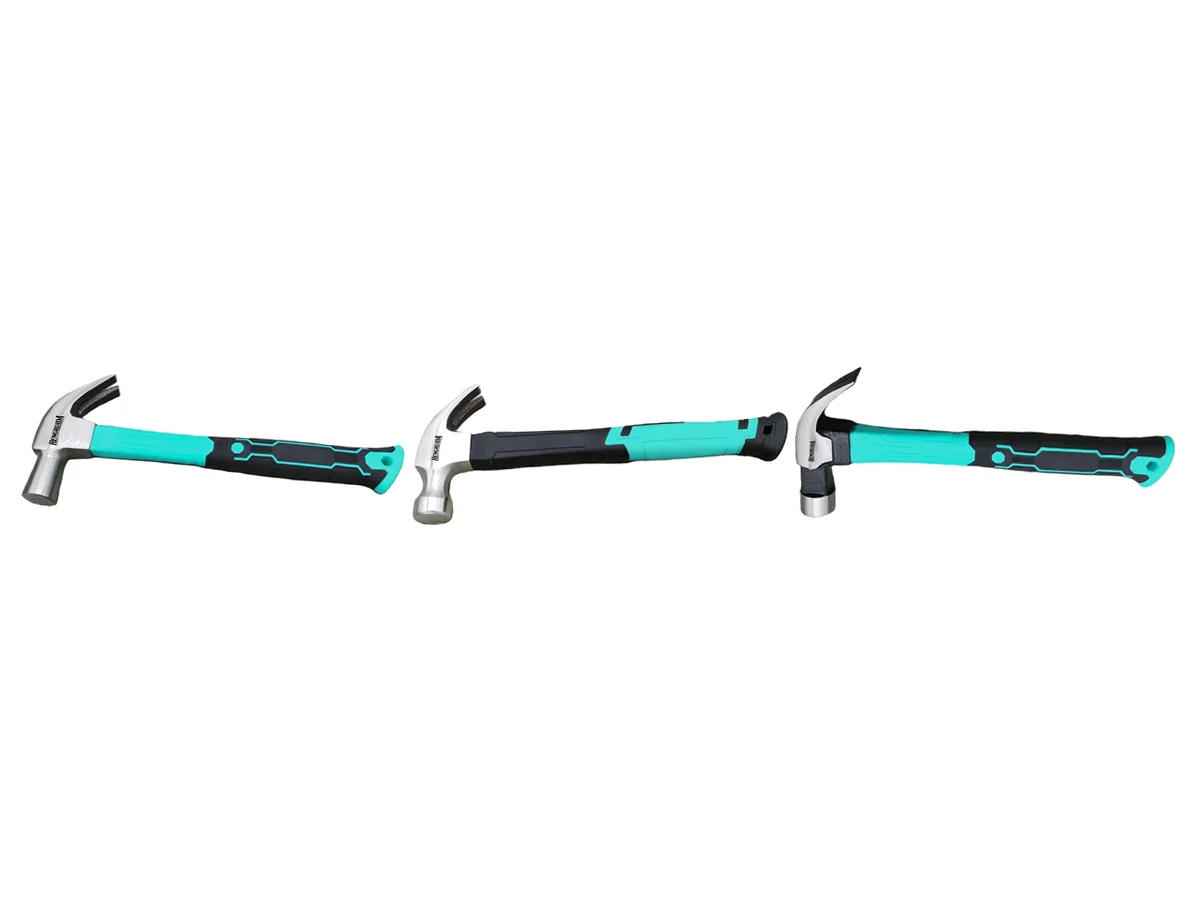
Quick answer: a claw hammer is defined by three choices — claw shape (curved or straight), head weight (8–24 oz) and handle material (hickory, fiberglass or TPR). Curved claws pull nails on finished work, straight claws give leverage for framing and demolition, 16 oz is the most common all-round size, and 20–24 oz is the framing range.
What are the main types of claw hammers?
Most catalogues list four working types. They share the same basic head — a flat striking face on one side and a split claw on the other — but differ in claw geometry, weight and handle length.
| Type | Claw shape | Typical weight | Main job |
|---|---|---|---|
| Curved claw hammer | Curved, rolled claw | 8–20 oz | Driving and pulling nails in finished and general work |
| Straight claw hammer | Straight claw | 16–24 oz | Framing, demolition, prying boards |
| Framing hammer | Straight claw, longer handle | 20–24 oz | Wall framing, decking, structural work |
| Finishing hammer | Curved, small face | 8–12 oz | Trim, cabinetry, light brads |
The category name is often used loosely. A buyer who asks for a “framing hammer” usually means a straight-claw hammer with a 16–18 in handle and a 20–24 oz head; a “finishing hammer” means a light curved-claw hammer with a smaller face.
Curved claw vs straight claw: which pulls better?
Claw geometry sets how the hammer levers a nail out. A curved claw rolls along the surface as it pulls, so the head stays supported and the nail comes out with less marking. A straight claw bites deeper and gives more leverage, which is why it is preferred for framing, demolition and pulling large or embedded fasteners.
| Property | Curved claw | Straight claw |
|---|---|---|
| Nail pulling | Smooth, rolling motion | High leverage, deeper bite |
| Surface marking | Low on finished wood | Higher, needs a block |
| Prying boards | Limited | Strong |
| Best for | Trim, furniture, general repair | Framing, demolition, pallets |
For a mixed retail range, the practical split is curved claw in 8–16 oz and straight claw in 16–24 oz. That covers both the DIY and the professional shelf without duplicating sizes.
Claw hammer vs framing hammer
A framing hammer is a claw hammer built for speed and force: heavier head, longer handle, straight claw and often a milled or checkered face that grips nail heads. A general-purpose claw hammer is lighter and shorter, which makes it easier to control for one-handed work.
| Spec | General claw hammer | Framing hammer |
|---|---|---|
| Head weight | 16 oz typical | 20–24 oz |
| Handle length | 12–14 in | 14–18 in |
| Claw | Curved or straight | Straight |
| Face | Smooth | Milled / checkered |
| Buyer | Retail, DIY, general trade | Framing crews, contractors |
Claw hammer sizes: 8–24 oz
Head weight is the specification buyers compare first. The table below is the range we produce most often; metric equivalents are included because many export markets order in grams.
| Head weight | Metric | Typical use | Handle |
|---|---|---|---|
| 8 oz | 225 g | Trim, light repair, camping | Hickory or TPR |
| 12 oz | 340 g | General DIY, finishing | Hickory or fiberglass |
| 16 oz | 450 g | All-round carpentry | Hickory, fiberglass or TPR |
| 20 oz | 570 g | Heavier framing, demolition | Fiberglass or hickory |
| 24 oz | 680 g | Framing, formwork | Fiberglass |
16 oz is the volume seller in most markets. 8–12 oz sells to DIY and finishing; 20–24 oz sells to contractors and to markets where a heavier head is the norm. For a fuller cross-category chart, see our hammer size and weight guide.
Handle options: hickory, fiberglass or TPR
The handle decides how much shock reaches the user and how the hammer behaves in cold or wet conditions. All three materials are available on the same head, so the handle is a market decision rather than a technical limit.
| Handle | Shock absorption | Durability | Best market |
|---|---|---|---|
| Hickory | High | Good, needs dry storage | Traditional trade, retail |
| Hardwood | High | Good | Value ranges |
| Fiberglass | Medium | Very high | Contractor, framing |
| TPR over-mold | High | High | Retail, ergonomic ranges |
TPR (thermoplastic rubber) over-molded handles are the fastest-growing segment in retail catalogues: they damp vibration, stay grippy when wet and allow colour coding by size. Our handle comparison covers the trade-offs in more detail.
Steel and hardness: what to ask a factory
Most claw hammer heads are drop forged from medium-carbon steel. C45 is the common choice; C55 gives a harder core for heavy striking. After forging, the head is heat treated and tempered to a working hardness of HRC 48–55 at the striking face — hard enough to resist deformation, tough enough not to chip.
- Ask for the steel grade in writing (C45, C55 or equivalent).
- Ask for the hardness range and the test method, not a single number.
- Ask whether the claw is forged in one piece with the head or welded on.
- Ask for a batch test report if the order is for a contractor brand.
Hardness is the specification buyers misunderstand most often. Our HRC 48–55 explainer covers what the number does and does not tell you.
How to choose by trade
| Trade | Head | Claw | Handle |
|---|---|---|---|
| General carpentry | 16 oz | Curved | Hickory or fiberglass |
| Framing | 20–24 oz | Straight | Fiberglass |
| Trim and finish | 8–12 oz | Curved | Hickory |
| Roofing | 20–28 oz | Straight | Fiberglass |
| Demolition / pallets | 24 oz | Straight | Fiberglass |
Wholesale and OEM notes
Claw hammers are one of the easier lines to private-label because the head, handle and packaging can be changed independently. Our standard customization thresholds are:
- Head, handle, surface treatment, logo, carton: from 600 pcs per model.
- Handle colour and retail packaging: from 1,200 pcs.
- Logo methods: laser marking, steel stamp or label, depending on the finish.
- Carton data: varies by head weight and handle length — confirm the packing list before booking freight.
For a full breakdown of options and lead times, see the OEM/ODM page or send us your specification.
FAQ
What is the difference between a curved and straight claw hammer?
A curved claw rolls as it pulls a nail, which protects finished surfaces. A straight claw bites deeper and gives more leverage for framing, demolition and prying. Curved suits trim and general work; straight suits structural and rough work.
What size claw hammer is most common?
16 oz is the most common all-round size in retail and general carpentry. 8–12 oz covers finishing and light DIY, while 20–24 oz is the framing range.
Is fiberglass or wood better for a claw hammer handle?
Fiberglass is more durable and handles wet conditions better; hickory absorbs shock better and is the traditional choice. For contractor ranges fiberglass usually wins; for retail and traditional markets hickory still sells.
Can claw hammers be customized with a logo?
Yes. Laser marking, steel stamping and labels are all possible, usually from 600 pcs per model. Handle colour and retail packaging start at 1,200 pcs.
What steel is used for claw hammer heads?
C45 is the standard medium-carbon choice; C55 is used for heavier or more demanding ranges. Heads are drop forged and heat treated to HRC 48–55 at the striking face.
Further reading
- Hammer size and weight guide
- Fiberglass vs wooden handles
- What HRC 48–55 means
- Claw hammer range (45 models)
- Sledge hammer range
Need a claw hammer quote?
Send the sizes, handle type and target market — we reply within 24 hours with price, MOQ and packing.
Request a Quote